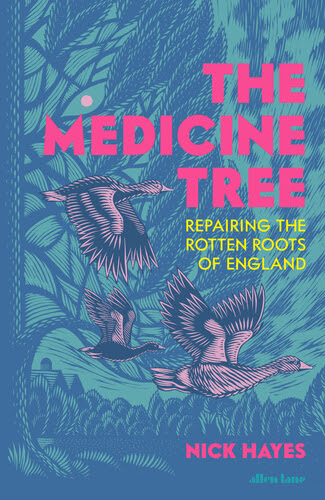
Our friend Nick Hayes’ new book is out! The Medicine Tree: Repairing the Rotten Roots of England chronicles the politics of land and global struggle for land justice, anchored in a beautiful account of the living community here at the Hardwick estate (where us Hempen folk are based). Nick has a way of turning folkloric memory into strident action, and this book is a great primer on the dire state of Britain’s countryside; namely its disconnection with the land, driven by an unbelievable disparity in ownership and abuse of an earthly tapestry that should not be owned by anyone, but rather shared in kinship by everyone.
Nick and our co-founder Patrick sat down together to talk about the radical importance of the book and Hempen’s place within it (spoilers!).
Watch the interview HERE!
***
Nick’s book has us revisiting a conversation we have often: LAND JUSTICE. In 1649, during the English Revolution, Gerrard Winstanley (leader of the True Levellers or “Diggers”) proclaimed “England is not a free people, till the poor that have no land, have a free allowance to dig and labour the commons.” The Diggers’ vision was of a societal relationship to land not as owners of it but as stewards and kin with it: nurture our ecosystems and they will nurture us. Today, nearly 400 years later, the commons have been almost entirely devoured by private enclosures.
Nowadays fewer than 1% of the population owns approximately half of England, creating an enormous power asymmetry between land-rich elites and the rest of us. It’s not a coincidence that it feels like there’s not enough space to survive – 92% (!!) of England’s land is legally off-limits to us the public, even just to enter.
Many of us at Hempen have lived with marginality and exclusion throughout our lives. It’s poignant that our radical little farm has fostered belonging amongst ragtags through the shared purpose of working with the land co-operatively. We get sentimental thinking about all the small agroecological communities that grow through the gaps of the UK’s patchwork zone of exclusion, in the spaces between the barbed-wire fences. At the same time, it’s a painful privilege to acknowledge that Hempen can only persist because of a graceful landowner, whose land we occupy, continuing to tolerate us.
And here is a seed of hope fluttering over on the winds of change: the Hardwick estate, from whose soil we grow, is taking pioneering steps to become the first community-led estate in England. Land justice is also about ecological harmony, strengthening biodiversity, and deepening territorial knowledge – and this comes from finding the humility within ourselves to relinquish full control.